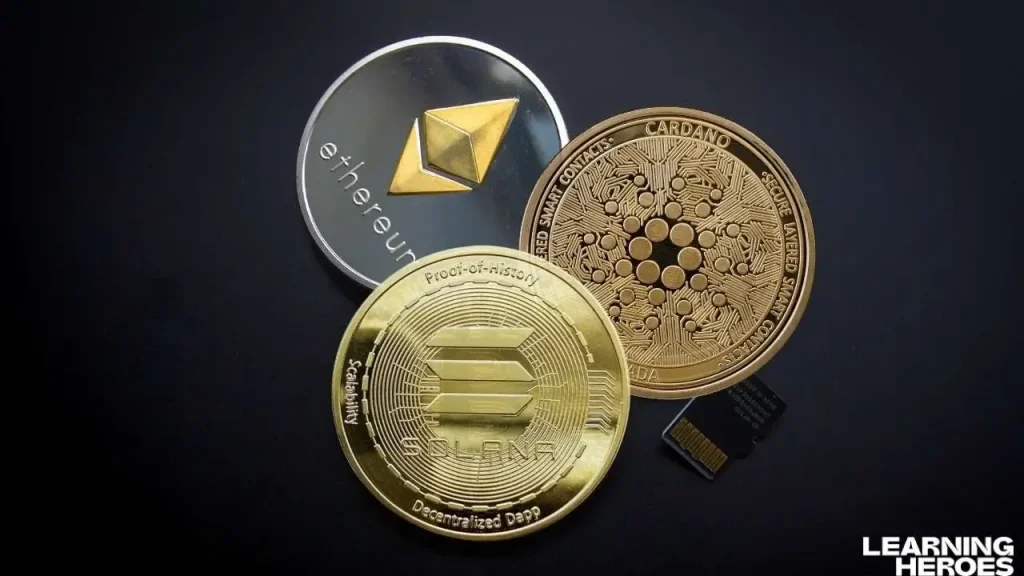

Ethereum, Solana, and Cardano all compete for the same role — a base layer where developers can build smart contracts, DeFi apps, and tokens — but they arrived at very different trade-offs to get there. Ethereum leans on security and the largest developer ecosystem in crypto; Solana bets on raw throughput and low fees; Cardano prioritizes a research-first, peer-reviewed approach to protocol changes. None of the three is strictly ‘better’ — the right answer depends on what you’re building or evaluating.
Key Takeaways
- Ethereum has the deepest liquidity, the most battle-tested smart contracts, and the largest base of developers and audited protocols — but that security and decentralization come at the cost of higher fees during network congestion.
- Solana is built for speed: sub-second block times and very low transaction costs, achieved through a more centralized validator set than Ethereum, which is the trade-off critics point to.
- Cardano takes the slowest, most methodical approach of the three, with protocol upgrades going through academic peer review before shipping — a process that builds confidence but has historically meant slower feature delivery.
- All three use proof-of-stake, but their approaches to consensus and validator decentralization differ meaningfully, which is what actually drives the speed/security/decentralization trade-offs between them.
- Layer-2 networks (like Arbitrum or Optimism for Ethereum) exist specifically to give Ethereum Solana-like speed and fees while still settling back to Ethereum’s base-layer security — so the ‘Ethereum vs Solana’ fee comparison looks different once L2s are part of the picture.
Ethereum vs Solana vs Cardano: Side by Side
| Ethereum | Solana | Cardano | |
|---|---|---|---|
| Consensus | Proof-of-Stake | Proof-of-History + Proof-of-Stake | Proof-of-Stake (Ouroboros) |
| Typical throughput | ~15-30 TPS on base layer (much higher via L2s) | Thousands of TPS | ~250 TPS |
| Typical fees | Variable, can spike with congestion | Fractions of a cent | Low and relatively stable |
| Smart contract language | Solidity | Rust | Haskell-based (Plutus) |
| Key strength | Ecosystem size, security, decentralization | Speed and low cost | Formal, peer-reviewed development process |
| Key trade-off | Base-layer fees/congestion | Historical network outages, more centralized validator set | Slower feature rollout |
Our Take
The framing of ‘which one will win’ is popular in headlines but doesn’t really match how this market has developed. Five years ago, the same question was asked about Ethereum vs. Bitcoin, and the answer turned out to be that both found distinct roles rather than one replacing the other. Ethereum’s moat isn’t raw speed — it’s the accumulated liquidity, audited contracts, and developer tooling that took years to build, which is exactly the kind of advantage that’s hard to route around even when a technically faster chain exists. Solana’s bet is that for many applications (payments, high-frequency trading, consumer apps with lots of small transactions) speed and cost matter more than that accumulated ecosystem depth, and its growing NFT and DeFi activity suggests that bet is paying off for specific use cases. Cardano’s slower, peer-reviewed cadence is a genuine trade-off, not just marketing — but it’s worth watching whether that caution translates into fewer of the exploits and outages that have hit both of the faster chains at various points.
For someone deciding where to build or where to pay closer attention, the practical filter is less ‘which chain is best’ and more ‘what does my use case actually need’: if you need maximum security and liquidity and can tolerate variable fees (or use an L2), Ethereum’s ecosystem is hard to beat; if you need cheap, fast transactions at scale, Solana is purpose-built for that; if you value a conservative, formally verified approach to protocol changes, Cardano’s process is the differentiator.
📎 Source: Learning Heroes — Ethereum vs Solana vs Cardano ¿cuál liderará en el futuro?