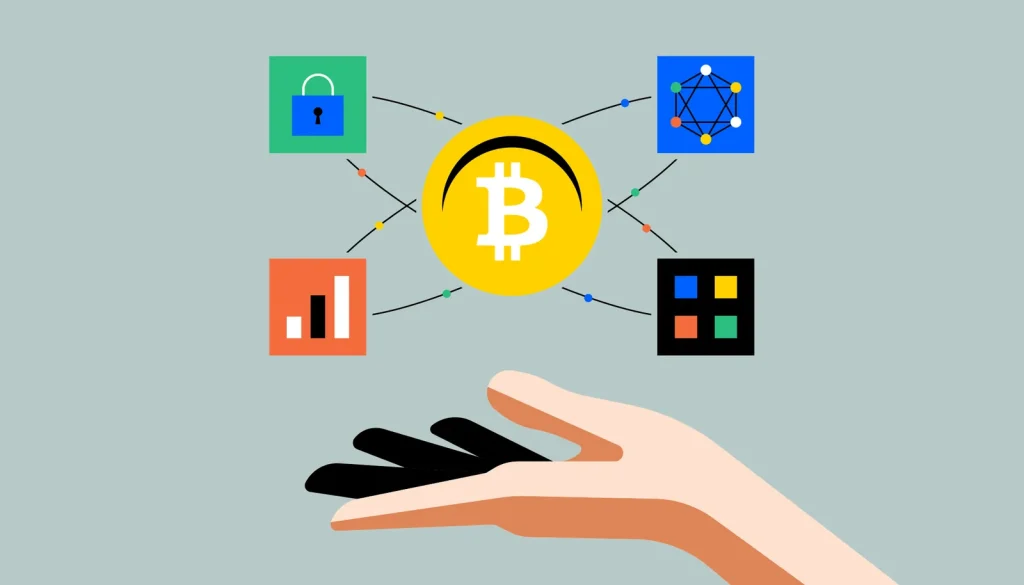

Bitcoin (BTC) is the original cryptocurrency: a decentralized digital currency that lets anyone send value directly to anyone else, anywhere in the world, without a bank or payment processor sitting in the middle. Since its 2009 launch, Bitcoin has grown from a niche cypherpunk experiment into a globally recognized asset class — but the core idea behind it, a public, tamper-resistant ledger secured by cryptography instead of a central authority, hasn’t changed.
Key Takeaways
- Bitcoin runs on a blockchain — a shared public ledger maintained by thousands of independent computers (nodes) instead of one company or government.
- There will only ever be 21 million BTC, and that cap is enforced by code, not by a policy that can be changed by a central bank.
- New bitcoin enters circulation through mining, and the reward for mining a block is cut in half roughly every four years in an event called the ‘halving.’
- You don’t need to buy a whole bitcoin — BTC is divisible down to 0.00000001, a unit known as a ‘satoshi.’
- Because Bitcoin is decentralized, no single entity can freeze your funds or reverse a confirmed transaction — which also means the responsibility for securing your private keys falls entirely on you.
Bitcoin vs. Traditional Bank Transfers
| Bitcoin | Bank / Card Payment | |
|---|---|---|
| Who controls it | No single company or government | Banks, card networks, regulators |
| Settlement time | Minutes to ~1 hour for full confirmation | Instant for the user, but 1-3 business days to fully settle |
| Availability | 24/7/365, globally | Business hours, subject to banking holidays |
| Supply | Fixed at 21 million BTC | Central banks can expand the money supply |
| Reversibility | Not reversible once confirmed | Chargebacks and reversals are possible |
Our Take
The debate that matters most for newcomers isn’t whether Bitcoin is real — at this point, with over a decade of uninterrupted operation and adoption by public companies and even a handful of nation-states as a reserve asset, that question is largely settled. The more useful question is what job you’re hiring it for. Bitcoin’s slow, deliberate block time and high fees during busy periods make it a poor fit for buying a coffee; that’s a use case better served by faster, cheaper networks. Where Bitcoin has genuinely earned its reputation is as a scarce, censorship-resistant store of value — digital property that can’t be diluted by a printing press and can’t be confiscated as long as you control your own private keys.
That last point is also Bitcoin’s biggest practical risk for beginners: self-custody means there’s no customer support line to call if you lose your recovery phrase or send funds to the wrong address. If you’re holding more than a small, ‘okay to lose’ amount, learning proper wallet security (hardware wallets, seed phrase backups, and avoiding custodial exchange balances for long-term holdings) matters just as much as understanding what Bitcoin is in the first place.
📎 Source: Coinbase Learn — What is Bitcoin?