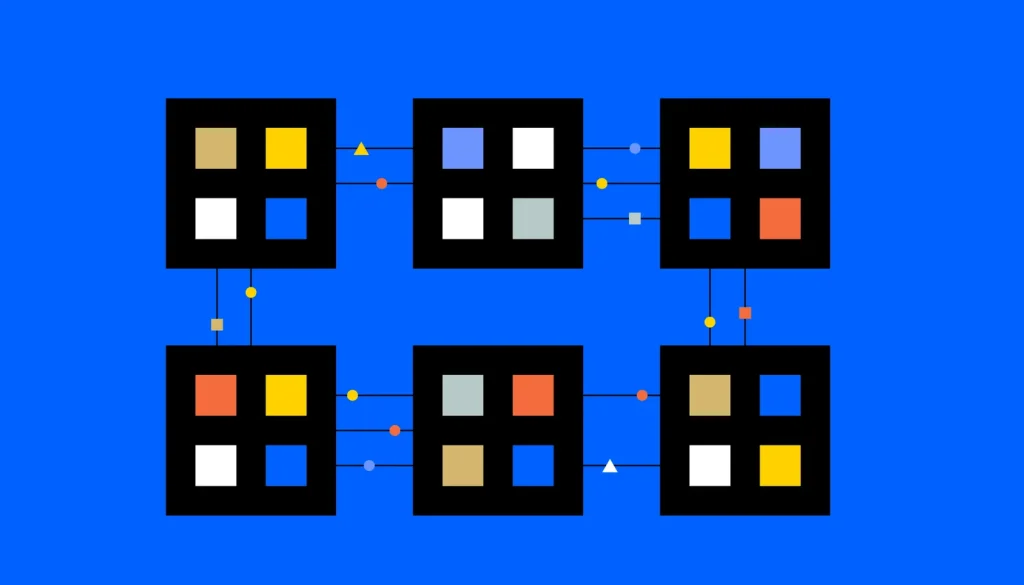

A blockchain is a shared, append-only record of transactions, copied across thousands of independent computers instead of stored on one company’s server. Each new batch of transactions (‘block’) is cryptographically linked to the one before it, which is what makes the history extremely difficult to alter after the fact — and it’s the foundation every cryptocurrency, from Bitcoin to Ethereum, is built on.
Key Takeaways
- A blockchain is a chain of ‘blocks,’ each containing a batch of transactions and a cryptographic reference to the previous block.
- The ledger is distributed: thousands of independent nodes hold a copy, so there’s no single point of failure or control.
- Changing old transaction history would require altering every block after it, on a majority of the network simultaneously — practically infeasible on established chains.
- Public blockchains are transparent: anyone can view the full transaction history using a block explorer.
- Different blockchains use different consensus mechanisms (like Proof-of-Work or Proof-of-Stake) to agree on which transactions are valid.
Our Take
It helps to separate two things people often conflate: the blockchain as a data structure, and ‘blockchain’ as a marketing term. The data structure itself is genuinely clever but fairly narrow — an append-only, cryptographically linked ledger that’s expensive to rewrite. What made it powerful wasn’t the data structure alone, but combining it with a decentralized network and an incentive mechanism (mining or staking rewards) that gets thousands of unrelated participants to agree on one shared history without needing to trust each other.
That combination is genuinely useful for a narrow set of problems — money, provable scarcity, censorship-resistant coordination — but it’s not a universal upgrade for every database problem, which is why so many ‘blockchain for X’ projects from 2017-2018 quietly used a regular database instead once the hype faded. When evaluating a blockchain-based project, the more interesting question usually isn’t ‘is it using a blockchain,’ but ‘does this specific problem actually need a decentralized, trust-minimized ledger, or would a normal database have worked just as well?’
FAQs
Who controls a blockchain?
For public blockchains like Bitcoin and Ethereum, no single entity controls it — it’s maintained by a distributed network of independent nodes and validators/miners who all follow the same rules.
Can blockchain data be deleted or changed?
In practice, no. Altering a past transaction would require redoing the cryptographic work for every subsequent block and getting a majority of the network to accept the altered chain, which is computationally infeasible on established networks.
📎 Source: Coinbase Learn — What is a blockchain?