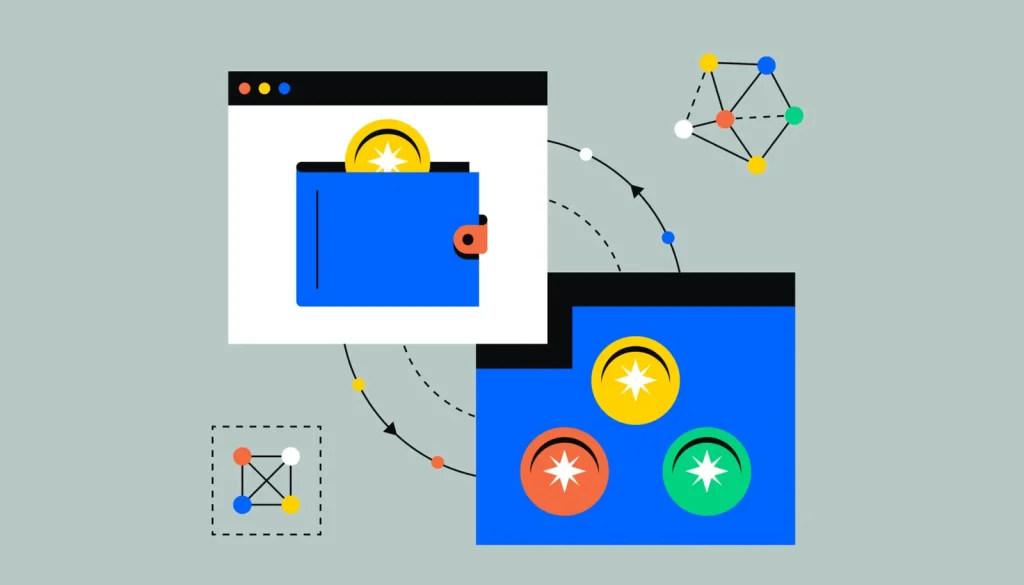

A decentralized application (DApp) is software that runs on a blockchain network rather than servers controlled by a single company. Instead of trusting a company’s backend, users interact with smart contracts whose logic is public, auditable, and — once deployed — can’t be unilaterally changed by any one party.
Key Takeaways
- DApps run their core logic through smart contracts on a blockchain, rather than on centralized servers a single company controls.
- Because the code is public and immutable once deployed, anyone can audit exactly what a DApp does — and, in theory, no one (including the developers) can secretly alter its behavior.
- Common DApp categories include decentralized exchanges, lending protocols, games, and social platforms.
- DApps typically require a crypto wallet to connect and interact, replacing traditional username/password logins.
- Trade-offs include scalability limits (blockchains process fewer transactions per second than centralized servers) and permanence — a buggy smart contract usually can’t simply be patched the way traditional software can.
Our Take
The ‘no one can change it’ property of DApps is simultaneously their biggest selling point and their biggest operational risk. A centralized app with a critical bug gets a hotfix pushed within hours; a DApp with a bug in its deployed smart contract often can’t be patched at all — the team may need to deploy an entirely new contract and migrate users, assuming the bug hasn’t already been exploited. That’s exactly why smart contract audits are treated so seriously in DeFi: the cost of shipping a bug is categorically higher than in traditional software.
For users, the practical implication is that ‘decentralized’ doesn’t automatically mean ‘safe’ — a DApp’s security depends entirely on the quality of its smart contract code and how thoroughly it’s been audited, not on the fact that it’s decentralized in the first place. Evaluating a DApp means looking at its audit history and time in production, not just its marketing claims about decentralization.
FAQs
Do DApps need a company to run them?
Not in the same way traditional apps do — a DApp’s core logic runs on the blockchain via smart contracts, so it can keep functioning even if the original development team stops working on it, though the front-end interface is often still maintained by a team.
Is a DApp automatically more secure than a regular app?
No. A DApp’s security depends on the quality and audit history of its smart contract code — poorly written or unaudited smart contracts have been the source of some of the largest hacks in crypto history.
📎 Source: Coinbase Learn — What are Decentralized Applications (DApps)?