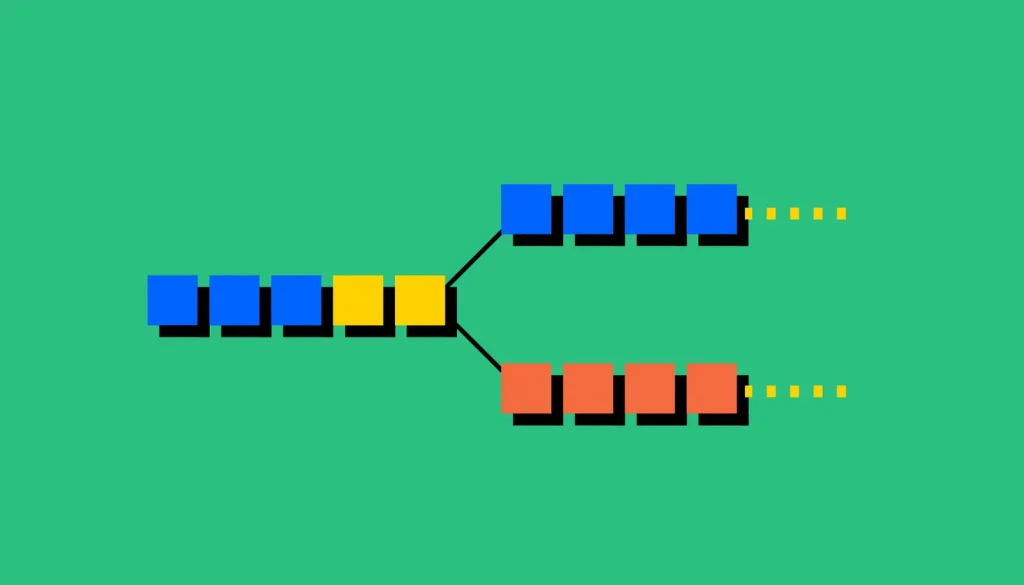

A fork happens when a blockchain’s community changes its underlying protocol rules, splitting the software (and sometimes the network itself) into a new version. Forks can be minor, backward-compatible upgrades, or they can be significant enough to create an entirely new, separate cryptocurrency — as happened when Bitcoin Cash split from Bitcoin in 2017.
Key Takeaways
- A soft fork is a backward-compatible rule change — nodes that haven’t upgraded can still validate blocks from upgraded nodes, so the network stays unified.
- A hard fork is a non-backward-compatible change — nodes running the old rules reject blocks from the new rules, which can split the network into two separate chains if consensus isn’t unanimous.
- Contentious hard forks (where the community disagrees) have historically produced new, independent cryptocurrencies, like Bitcoin Cash forking from Bitcoin and Ethereum Classic forking from Ethereum.
- Forks are a normal part of blockchain governance and upgrades — most are planned, uncontroversial, and don’t result in a permanent chain split.
- Holders of the original coin at the time of a contentious hard fork typically receive an equivalent balance of the new forked coin as well.
Hard Fork vs Soft Fork
| Soft Fork | Hard Fork | |
|---|---|---|
| Backward compatible? | Yes | No |
| Requires all nodes to upgrade? | No | Yes, to stay on the same chain |
| Can split the network permanently? | Rarely | Yes, if consensus isn’t unanimous |
| Example | Bitcoin’s SegWit upgrade | Bitcoin Cash split from Bitcoin |
Our Take
Forks are ultimately a governance mechanism disguised as a technical one: they’re how a decentralized community with no central authority resolves fundamental disagreements about a protocol’s direction. When the disagreement is minor, a soft fork lets the network upgrade smoothly. When the disagreement is fundamental enough — as with the block-size debate that led to Bitcoin Cash — a hard fork lets both factions get exactly what they want, simply by going their separate ways with separate chains.
That’s arguably a healthier outcome than the alternative in a centralized system, where a single company’s decision on a contentious issue would be final regardless of dissent. The trade-off is that contentious forks are genuinely disruptive: dividing developer talent, liquidity, and brand recognition between two chains, and, in Bitcoin’s case, definitively demonstrating years later which faction’s approach the market actually valued more.
FAQs
What happens to my coins during a hard fork?
If you held the original cryptocurrency at the time of a contentious hard fork, you typically end up owning an equivalent balance on both the original chain and the new forked chain.
Are most forks contentious splits?
No. Most forks are planned, uncontroversial protocol upgrades (often soft forks) that the community broadly agrees on — contentious hard forks that split into two separate cryptocurrencies are relatively rare.
📎 Source: Coinbase Learn — What is a fork?