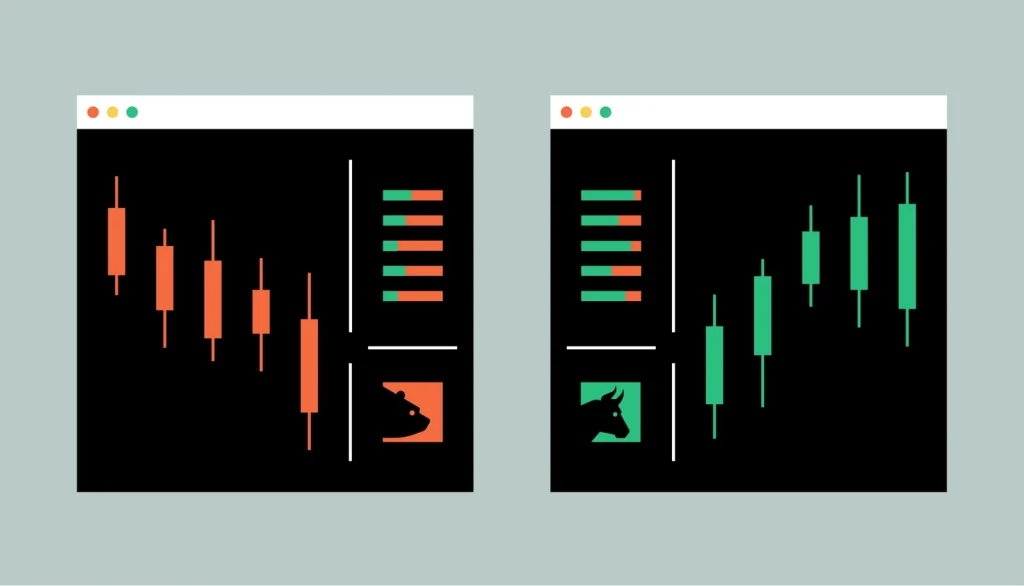

A bull market describes a period of sustained, substantial price growth; a bear market describes a period of sustained, substantial decline. The terms apply to any asset class — stocks, real estate, crypto — and understanding which phase a market is in (or believed to be in) shapes everything from trading strategy to simple emotional expectations.
Key Takeaways
- There’s no single universal threshold, but a common rule of thumb defines a bear market as a decline of 20% or more from recent highs, sustained over time.
- Bull and bear labels are usually applied in hindsight with more confidence than in real time — identifying a turning point as it happens is notoriously difficult.
- Crypto bull and bear cycles have historically been more extreme in magnitude than traditional markets, with larger percentage swings in both directions.
- Sentiment tends to become self-reinforcing in both directions: bull markets attract more buyers and media attention, which can extend the trend; bear markets do the same in reverse.
- Strategy often shifts by market phase — accumulation and patience tend to suit bear markets, while risk management and profit-taking discipline matter more in euphoric bull markets.
Our Take
The trap that catches even experienced market participants is assuming the current phase will persist indefinitely — extrapolating a bull market’s gains forward as the new normal, or a bear market’s pain as permanent. Crypto’s cycles have historically been sharper than traditional markets in both directions, which makes this bias even more costly here: the euphoria near a bull market top and the despair near a bear market bottom are both, in hindsight, usually the worst possible times to make major portfolio decisions based purely on recent price action.
A more durable approach than trying to precisely call the top or bottom is having a predetermined strategy for each phase, decided in advance, before emotions are running high: a plan for how much to accumulate during drawdowns, and a plan for taking some profit during euphoric rallies, set while thinking clearly rather than reacting to the market in real time.
FAQs
How is a bear market officially defined?
There’s no single universal rule, but a common convention defines a bear market as a decline of roughly 20% or more from recent highs, sustained over a meaningful period rather than a brief dip.
Are crypto bull and bear markets more extreme than stocks?
Historically, yes — crypto markets have shown larger percentage swings in both directions compared to traditional stock market cycles, reflecting crypto’s relatively smaller size, higher volatility, and different investor base.
📎 Source: Coinbase Learn — What is a bull or bear market?